
For centuries, people have blamed the moon for everything from sleepless nights to strange behavior. The word “lunacy” literally comes from luna, the Latin word for moon. Hospital workers swear emergency rooms get busier during full moons. Parents claim their kids act more wildly.
But is there any truth to it? Or is it just folklore?
As a data scientist, I conducted extensive research on that front. Starting with the emergency room influx. But a study conducted by Zargar et.al. (2004) refutes the notion of such influence.
However, later studies claim something very different. I tend to believe there is a correlation between the lunar calendar and people’s mood.
I decided to find out—not by reading studies, but by analyzing my own journal.
The Science: What Researchers Actually Found
Before diving into my data, I wanted to know what science says. Turns out, the research is more interesting than I expected.
A 2021 study published in Science Advances tracked sleep patterns across indigenous communities in Argentina and college students in Seattle. The findings were consistent: people tend to go to sleep later and sleep for shorter periods of time in the nights leading up to a full moon. This happened regardless of whether participants had access to electricity. Crazy, right?
The effect is modest but measurable. Most people lose only 15 to 30 minutes of sleep around a full moon, but the changes are real—people take longer to fall asleep and spend less time in deep, restorative sleep.
Why does this matter for mood? Because sleep and mood are deeply connected.
Melatonin, the hormone that calms your body for sleep, rises at night while serotonin—the “feel-good” hormone—decreases. According to Cleveland Clinic, bright light from a full moon can disrupt this balance, affecting both sleep quality and emotional regulation.
Cleveland Clinic psychologist Dr. Susan Albers notes that while much of the research on lunar effects has been “anecdotal” and “conflicting,” studies have shown a possible correlation between the moon and human activity—particularly for people with bipolar disorder, whose mood cycles sometimes synchronize with lunar phases.
The connection isn’t fully understood. But the pattern keeps showing up.
My Experiment: 180 Journal Entries, 8 Moon Phases
I’ve been journaling consistently for years. Recently, I created Reflekt, an app that tracks certain analytics about me. I decided to start tracking something new: how my writing sentiment correlates with the lunar cycle.
Why did I choose to use writing sentiment over my own feelings? I break it down in this post why your writing is a more reliable data point than an answer from a dropdown on your feelings for the day.
Using Reflekt, I analyzed all of my journal entries across all eight moon phases. And the end results were startling. Each entry was scored for emotional sentiment on a scale from -1 (negative) to +1 (positive).
In the last 180 days, this is what the data showed:
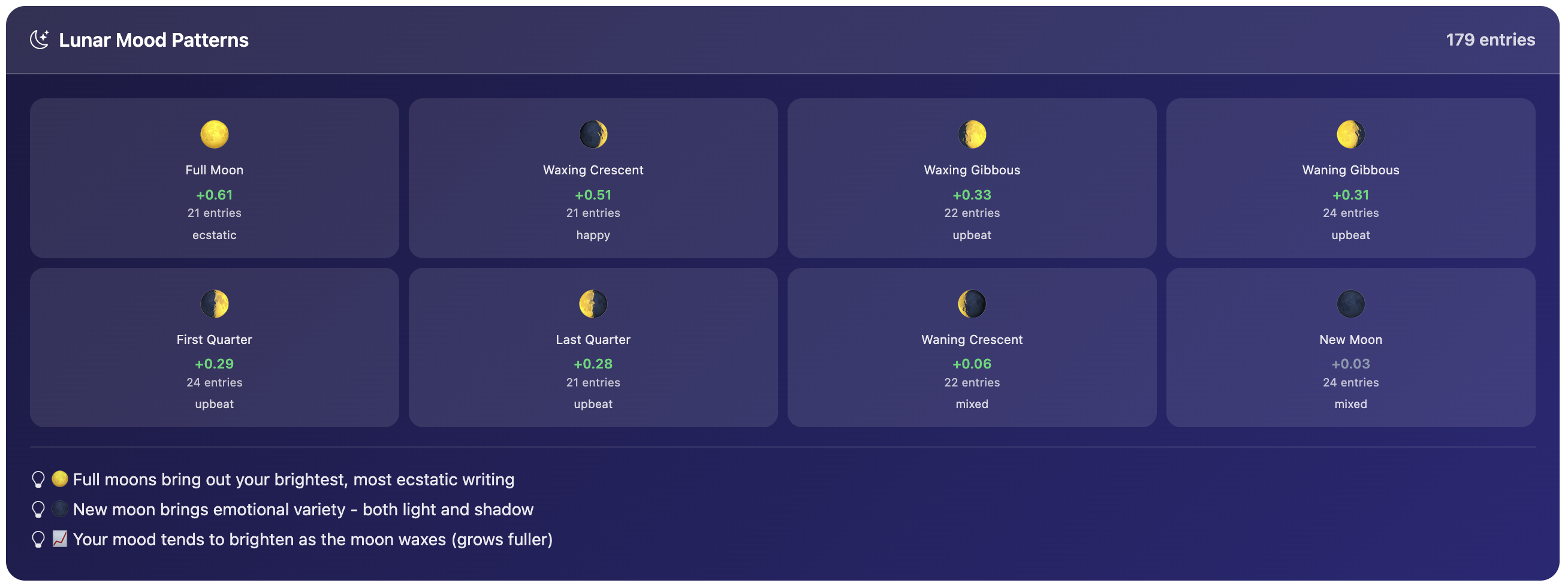
| Moon Phase | Sentiment Score | Entries | Mood Label |
|---|---|---|---|
| Full Moon | +0.61 | 21 | Ecstatic |
| Waxing Crescent | +0.51 | 21 | Happy |
| Waxing Gibbous | +0.33 | 22 | Upbeat |
| Waning Gibbous | +0.31 | 24 | Upbeat |
| First Quarter | +0.29 | 24 | Upbeat |
| Last Quarter | +0.28 | 21 | Upbeat |
| Waning Crescent | +0.06 | 22 | Mixed |
| New Moon | +0.03 | 24 | Mixed |
The pattern is clear: I’m happiest during the full moon (+0.61) and least happy during the new moon (+0.03). That’s a 20x difference in sentiment score.
What This Means (And What It Doesn’t)
I’m not claiming the moon controls my emotions. Correlation isn’t causation.
But here’s what I know for sure: there is a pattern in my data. And I never would have seen it without tracking.
Maybe the full moon’s light keeps me up later, and I’m more productive at night. Maybe I’m unconsciously more social when moonlit evenings feel inviting. Maybe it’s a pure coincidence that happens to repeat.
The point isn’t to prove lunar influence. The point is that patterns exist in your life that you can’t see without looking for them.
Your journal already contains this data. You’ve been writing about your moods, your energy, your struggles—without ever connecting the dots.
The Bigger Picture: Your Journal Knows Things You Don’t
This moon analysis is just one example. My journal also revealed:
- I’m measurably more negative on Sundays
- My best ideas cluster in 10-day cycles
- I’ve written about “feeling stuck” hundreds of times without realizing the pattern
These aren’t things I could have noticed in the moment. They only emerged when I looked at the data over time.
That’s the difference between journaling and journaling with insight.
Try It Yourself
You don’t need 180 entries to start noticing patterns. Even a few weeks of consistent journaling can reveal things like:
- Which days of the week are hardest for you
- What topics you keep circling back to
- Whether your mood correlates with sleep, exercise, or yes—moon phases
The key is having a way to see what you’ve written, not just store it.
That’s why I built Reflekt. It’s a journaling app that analyzes your entries for sentiment, tracks patterns over time, and shows you insights you’d never find on your own—including lunar correlations.
Your journal has been trying to tell you something. Maybe it’s time to listen.
Start Finding Your Patterns
Reflekt analyzes your journal entries automatically—tracking mood, themes, and yes, moon phases. See what your writing reveals about you.
What About You?
I’m curious: Do you notice changes in your mood or energy around the full moon? Or do you think it’s all folklore?
If you’ve been journaling, look back at your entries from the past few full moons. See if anything stands out.
And if you want a tool that does the analysis for you, Reflekt is free to start.
The moon may or may not affect your mood. But your journal definitely contains patterns worth discovering.